

I am really tired of the hatred between the Arabs and the Jews. I guess they must have really enjoyed this suffering and pain. Here is a nice memo dedicated to Israel.
1. The most recent order by Israel: "I ask all the civilians in the southern part of Lebanon to leave their homes!"
2. The next order: "I ask all the civilians around my country to leave their homes. These countries include, Palestine, Lebanon, Syria, Iraq, Kuwait, Saudi Arabia, Jordan, Egypt, etc. Although, Iran is not exactly around my country, I also ask them to leave their homes, since they will soon be my neighbors!"
3. Final order: "I ask all the civilians in the world to leave their homes for their own sake. Due to recent achievements of Israel, and the already happened arrival of the final Prophet, the citizens of the promised land is about to be awarded the final promise of apocalypse!"
July 16, 2006
Three Orders from Israel

July 14, 2006
Word of the Dai
"Is it really necessary to kill at least 100,000 people, to get rid of a single Dictator?"
Dr. Mohamed ElBaradei, the Director General of the International Atomic Energy Agency.
UPDATE: Response from Sheriff of the World
"Yes. I, the ancestor of Stalin, am ready to do whatever it takes to make the world taste and feel my happiness. Mine and only mine..."
July 12, 2006
Gunun yazisi - Melih Asik'tan
Kalite dorukta!..
Meclis Başkanı Arınç, Moskova'da Lenin'in mozolesi önünde yaptığı espriyle ne kadar yüksek kalibrede bir devlet adamı olduğunu bir kez daha gösterdi:
"Lenin'i ölü olarak görmek çok güzel."
Hakkını yemeyelim, diğer AKP'li siyasiler de o ölçüde esprili ve nitelikli kişiler!..
Maliye Bakanı hayali ihracattan vergi kaçakçılığına kadar... Maliyenin her alanında deneyim ve hüner sahibi olmasa, bugün bakanlık koltuğu yerine mali suçlu olarak hapiste olmaz mıydı?..
Kültür Bakanı icraat sırasında uyuyabilen ve müzelerin soyulmasını görmezden gelebilen bir zekâ...
Milli Eğitim Bakanı imam hatip mezunlarını üniverseteye sokma konusunda başarıya doğru ilerliyor. Bunu başarınca diğer konulara da sıra gelecek...
Sağlık Bakanı, Bayındırlık Bakanı, Tarım Bakanı... Hepsi ayrı değer... Danışmanlar da öyle... Cüneyd Bey fındık ve pot kırma ustası... Basın danışmanı Beki'nin kamuoyuna yalan söylediğini dün bizzat Başbakan açıkladı...
Bu kadronun lideri Başbakanımız ise şu anda dünya siyasetinde bir yıldız gibi parlıyor... Özellikle itibarlı dostlarıyla ilgi çekiyor; Afgan mücahidi Gülbeddin Hikmetyar, Hamas lideri Halit Meşal, terör finansörü Yasin El Kadı bu muteber isimlerden birkaçı...
Danışmanı Zapsu'nun onu Washington'da "Bu adamı kanalizasyona süpürmeyin" diye savunmasından mutluluk duyuyor. Uluslararası görüşmelerde pot kırması ayağına basılarak önleniyor...
Böylesi bir kalite ve kadro zenginliği yaşıyor Türkiye...
Başbakan El Kadı'ya kefilmiş.
Fiskobirlik'e de kefil olsa da, perişan fındık üreticinin emeği çarçur olmasa!
Gülhan Elmas
Yabancıya satış...
Efendim gurbetçimiz Avrupa'da herhangi bir ülkeden ev, dükkân, apartman almıyor mu? Elbet elin yabancısı da gelip istediği yerden ev, arsa, villa, yalı alabilmeli. Ne var bunda? Üstelik yabancı sermayeye de ihtiyacımız var... Para gelsin... Yüzeysel bakınca bu mantık doğru gibi görünüyor. Acaba olay bu kadar basit mi?...
Erciyes Üniversitesi'nde yabancılara toprak satışına ilişkin bir proje yürütüldü, ayrıntılı çalışma yapıldı, bir rapor hazırlandı. Proje sorumlusu Yard. Doç. Ayşe Odman Boztosun'la konuştuk dün...
Yabancılara toprak ve emlak satışıyla ilgili olarak gözden kaçan veya kaçırılan noktalara dikkati çeken Boztosun dedi ki:
- Köşe yazarları daha çok yabancı kişilerin Türkiye'de edindikleri taşınmazlara odaklanıyor. Böylece Türkiye'de en fazla taşınmaz edinenler Yunan ve Suriyeliler, tatil yörelerinde de Almanlar ve İngilizler gibi görünüyor. Ancak 2003 - 2005 yılları arasında, 2 yıl boyunca, eski yasa Anayasa Mahkemesi tarafından iptal edilene kadar, yabancı ticaret şirketleri, Türkiye'de sınırsız şekilde taşınmaz edindi... Ne kadar? Bilinmiyor. Bu bilgi bugün maalesef Tapu ve Kadastro Genel Müdürlüğü'nde bile mevcut değil...
- Bugünkü durumda tam bir denetim var mı?
- Maalesef hayır... Kişilerle ilgli mütekabiliyet esası gibi sınırlamalar var, ama yabancılar Türkiye'de şirket kurarak tıpkı bir Türk şirketi gibi istediği kadar, istediği yerde taşınmaz edinebilir...
- Bir yabancı ülke kendi işadamlarına Türkiye'de ortak şirket kurdurdu, diyelim ki sınır bölgesinden yüzlerce dönüm arazi aldırdı. Bundan bizim haberimiz olmaz mı?
- Olmaz... Çünkü bu konuda bir denetim yok.
- Dış ülkelerde bu konuda tam bir serbestlik var mı?
- İsviçre ve Danimarka gibi ülkelerde ikâmet etmiyorsanız toprak ve emlak alamazsınız. Birçok ülke bu kuralı uygular. Türkiye'deki kadar geniş serbestlik ve denetimsizliğin benzerini bulmak zordur...
AB siyasetçilerinden Lagendijk, "Türkiye'de daha çok bölgesel özerklik gerekiyor" demiş.
Ülkenizi bölün demeyecek kadar nazik bir adam...
Haldun Ertem
July 9, 2006
Interesting Genetical/Philological Research - Are the Italians come from the Turks?
Translation of possibly another translation - so as a warning, don't forget that mistakes are also a part of the life - do not hesitate to search for the real truth if you think what given below is not.
Italians, who consider the Turks as barbarians, are in shock. Lately, it has been proven that the Italians' DNA matches the Turks' DNA with 97%. Now, it is also claimed that the alphabet of the Etrusks, who are considered to be the ancestors of the Italians, is of Turkish origin.
The first thing that comes to the mind of anyone, who is familiar with both the Italians and the Turks, is how the Turks and Italians are close to each other both physically and characteristically. It is interesting that the people of both of these Mediterrenanen countries are like friends even if they haven't met each other. In the recent years, Italian science community has started discussions to find the origins of their ancestors, or whether they are Turks or not...
What lies in the middle of those discussions is the clan/tribe of Etrusks, who are considered as part of Pre-Turks. Etrusks had established the oldest culture in Italy. It is known that the Etrusks have come from the Austrian Alpines to Siena, Napoli, and Rome in 1000 BC. After they established a glorious civilization, they had been erased from the history scene in 300 BC. The region from Florence to Napoli has been known as Etruria. Also, the people who are living in this region call themselves as Etrusk. Since the Etrusks have been considered as a mysterious tribe, there have been neverending discussions regarding their origins.
The first written document belonging to the Etrusks was found in 1780. But, what ethnicality the Etrusks have represented had been an unknown despite the archeological findings. Because, no Western researcher has been able to decipher the Etrusk writings, which were written with characters highly similar to those in Latin alphabet. Researchers from the Toscana University, who are known to do detailed researches on Etrusks, investigated the DNA of Etrusks by taking samples from the skeletons found in Etruskian graves. They have compared the samples to many races around the world. And, interestingly (but naturally), the samples had shown 97% match to the DNAs of the Turks. Italians, who have called the Turks as barbarians for centuries, who have created the slogan "Alas (or oh mama), the Turks are coming!", have been shocked by these findings. This topic has started big discussions in the Italian science community.
Now, we give the microphone to ethnologist and art-historian Haluk Tarcan, who has also claimed that the Italians come from the Turks using ethnological and archeological findings as proofs.
2nd part is coming soon...
July 7, 2006
World Basketball Championship - a small analysis of the Turkish National team
Turkish National team has always been a part of highly controversial decisions and the resulting discussions in the last few years. This year is no different. I have a couple of words (in Turkish) for some who put their personal interests above the national interest.
Dogruyu soylemek gerekirse milli takima yillarca hizmet vermis olan, ve buna ragmen her turlu basarisizlikta kinci, cikarci, ve Turk basketbolunu batiran isimler tarafindan suclanan Hidayet ve Mehmet'in (umarim son sampiyonadan sonraki Dogan Hakyemez denen kiskirtici, laf tasiyici, ve ara bozucu sahsin aciklamarina kulaklarinizi tikamamissinizdir), bu kisilerin hala takimin basinda olmasi dolayisiyla takima katilmak istememeleri acaba hic mi akliniza gelmiyor? Eger o takimdan Dogan Hakyemez atilsaydi ve antrenor olarak adam gibi birisi konulsaydi (orada alin teri dokebilecek, sampiyonadan sampiyonaya da olsa gorev yapabilecek bayagi bir isim var) acaba Mehmet ve Hidayet gerekli ozveride bulunabilirlermiydi? Bence sagliklari izin veriyorsa kesinlikle.
Ayrica gecen sampiyonada hatirliyorum acik bir sekilde "Federasyonun yalakasi" olan isimler bas sorumlu olarak Mehmet ve Hidayet'i gormuslerdi ve takima bir daha alinmamalari talep edilmisti. Ne oldu da simdi tekrar bu iki isme sarildilar, acaba Federasyonun son yillarda Turk basketboluna indirdigi hancerin etkilerini bir sure daha gizlemek icin mi (tesadufi de olsa basari olursa, basari Turgay Demirel ve Dogan Hakyemez'in olacak, basarisizliktaysa bas sorumlu NBA'li oyuncularin cikardigi huzursuzluk olacak)? Sebep ne olursa olsun bu kisilerin cikip da ortalikta Hidayet ve Mehmet'i vatan hainligiyle suclayip, halki onlara karsi kiskirtmalari hem asagilik bir davranis hem de abesle istigalden ote degil.
Ayrica hala bizden ileride olan Fransiz basketbolunun yasandigi ulkede saygiyla anilan Huseyin gibi bir basketbolcunun milli takima davet edilmemesinden dolayi acaba Turgay Demirel ve Dogan Hakyemez'in yaptigini vatana ihanet olarak gorurmusunuz? Yoksa, belli bir koronun uyesi ve cikarin temsilcisi olarak, bu gercegi gizlemek icin gozunuze uyku gozlugu, kulaginiza kulak tikaci mi takmayi tercih edersiniz?
Ben gecen sampiyonadan sonra beklenenin cok altinda performans ortaya koyduklari icin ilk olarak Hidayet ve Mehmet'i sorumlu gormustum, cunku NBA'li oyuncular olarak her kosulda ustun bir oyun sergilemelerini beklerdim. Ama Mehmet'in performans dusuklugunun sebebi belliydi ve hakli bir sebebi vardi. Hidayet'te psikolojik olarak problemlerden cok kolay etkilenen birisi. Ve gectigimiz milli takimdaki problemler ve gruplasmalar goz onune alinirsa kendini verememesinin sebebi cok rahat ortaya cikar. Ben de onun yerinde olsam problemlerden uzakta kalmak icin milli takima son haftada katilirim, diger oyuncularla iliskilerimin en azda olmasini saglarim, ve sadece verilen gorevi yerine getirip ekstradan hic bir seyle ugrasmam. Bu ne demek oluyor, sagolsun milli takimin basindakiler ve sizin gibiler benim icindeki milli takim sevgisini oldurdu demek oluyor. Ve kesinlikle hak veriyorum.
Umarim taktiginiz gozlugu cikarip baskalarinin olaya bakis acilarini da dikkate alirsiniz. Sonucta bu ne sadece sizin milli takiminiz ne de sadece benim milli takimim.
Ayrica gecen sampiyonada hatirliyorum acik bir sekilde "Federasyonun yalakasi" olan isimler bas sorumlu olarak Mehmet ve Hidayet'i gormuslerdi ve takima bir daha alinmamalari talep edilmisti. Ne oldu da simdi tekrar bu iki isme sarildilar, acaba Federasyonun son yillarda Turk basketboluna indirdigi hancerin etkilerini bir sure daha gizlemek icin mi (tesadufi de olsa basari olursa, basari Turgay Demirel ve Dogan Hakyemez'in olacak, basarisizliktaysa bas sorumlu NBA'li oyuncularin cikardigi huzursuzluk olacak)? Sebep ne olursa olsun bu kisilerin cikip da ortalikta Hidayet ve Mehmet'i vatan hainligiyle suclayip, halki onlara karsi kiskirtmalari hem asagilik bir davranis hem de abesle istigalden ote degil.
Ayrica hala bizden ileride olan Fransiz basketbolunun yasandigi ulkede saygiyla anilan Huseyin gibi bir basketbolcunun milli takima davet edilmemesinden dolayi acaba Turgay Demirel ve Dogan Hakyemez'in yaptigini vatana ihanet olarak gorurmusunuz? Yoksa, belli bir koronun uyesi ve cikarin temsilcisi olarak, bu gercegi gizlemek icin gozunuze uyku gozlugu, kulaginiza kulak tikaci mi takmayi tercih edersiniz?
Ben gecen sampiyonadan sonra beklenenin cok altinda performans ortaya koyduklari icin ilk olarak Hidayet ve Mehmet'i sorumlu gormustum, cunku NBA'li oyuncular olarak her kosulda ustun bir oyun sergilemelerini beklerdim. Ama Mehmet'in performans dusuklugunun sebebi belliydi ve hakli bir sebebi vardi. Hidayet'te psikolojik olarak problemlerden cok kolay etkilenen birisi. Ve gectigimiz milli takimdaki problemler ve gruplasmalar goz onune alinirsa kendini verememesinin sebebi cok rahat ortaya cikar. Ben de onun yerinde olsam problemlerden uzakta kalmak icin milli takima son haftada katilirim, diger oyuncularla iliskilerimin en azda olmasini saglarim, ve sadece verilen gorevi yerine getirip ekstradan hic bir seyle ugrasmam. Bu ne demek oluyor, sagolsun milli takimin basindakiler ve sizin gibiler benim icindeki milli takim sevgisini oldurdu demek oluyor. Ve kesinlikle hak veriyorum.
Umarim taktiginiz gozlugu cikarip baskalarinin olaya bakis acilarini da dikkate alirsiniz. Sonucta bu ne sadece sizin milli takiminiz ne de sadece benim milli takimim.
June 18, 2006
Dancing Links in Sudoku continued
Source: http://www.setbb.com/sudoku/viewtopic.php?p=6068&mforum=sudoku#6068
You should realize that DLX is not designed for sudoku. It is a generic algorithm to solve Exact Cover problems. In fact, many terms are used for different things in DLX and sudoku.
Column
A simple constraint in sudoku. There are 81 columns for each cell, 81 for 9 digits in 9 sudoku-rows, 81 for 9 digits in 9 sudoku-columns and 81 for 9 digits in 9 sudoku boxes. This creates a total of 324 columns.
Row
A candidate in sudoku. There are 9 candidates in 81 cells, creating 729 rows.
Node
An connection between a row to a column. Each row has 4 nodes, one for each of the 4 constraints that it links to.
Example
Take candidate R2C7D6.
It is represented by Row[(2-1)*81+(7-1)*9+(6-1)]
It has a Node for the column representing the cell: [(2-1)*9+(7-1)]
It has a Node for the column representing digit 6 in sudoku-row 2: [81+(2-1)*9+(6-1)]
It has a Node for the column representing digit 6 in sudoku-column 7: [162+(7-1)*9+(6-1)]
It has a Node for the column representing digit 6 in sudoku-box 3: [243+(3-1)*9+(6-1)]
When setting up a DLX grid, make sure you can address the nodes from the rows. I usually define a FirstNode property in the Row object.
729 Rows with 4 Nodes each creates 2916 Nodes in total.
324 Columns each have 9 Nodes attached.
Classes
If you are not familiar with object oriented programming, the following part may be difficult to understand.
| Code: |
| class Node { Node Up; Node Down; Node Left; Node Right; Header Head; } class Header : Node { int Size; } |
Initially, a Header has no detail nodes connected to it. You should initialize a Header like this:
| Code: |
| this.Up = this.Down = this.Head = this; this.Size = 0; |
When detail nodes are initialized, link them to their header like this:
| Code: |
| this.Down = this.Head.Down; this.Up = this.Head; this.Head.Down.Up = this; this.Head.Down = this; this.Head.Size++; |
Link-Unlink
Each column has a header node. In an object-oriented language, the Header class is inherited from the Node class. You can also implement properties like IsHeader in the Node class.
Nodes are connected to the column header using a double linked list. Each node has Up and Down properties to the adjacent nodes. The column header node is part of both lists.
All nodes belonging to the same Row are connected with Left and Right properties. Most implementations do not use Row headers. The last Node of the row links back to the first. These left-right lists are static. They will not change after the initial setup.
To unlink a node, simply connect the 2 adjacent nodes to each other with the following operation:
| Code: |
| this.Up.Down = this.Down; this.Down.Up = this.Up; this.Head.Size--; |
This removes a node from the list. Notice that the Header.Size property is also decremented.
The powerful thing about DLX is that this operation can easily be reversed. The node still 'knows' where it was located in the list. The following operation restores the original links:
| Code: |
| this.Up.Down = this; this.Down.Up = this; this.Head.Size++; |
This is only true when we can be assured that the list is in the same state it was after the node was unlinked. The recursive DLX algorithm takes care of this.
Column Headers
Header nodes use the Left and Right properties in a slightly different way. All headers are linked to each other in a doubly linked list using the Left and Right properties.
A Root will be used as the starting point for these Header lists. Initialize the Root like this:
| Code: |
| this.Left = this.Right = this; |
Additional Headers are connected to the Root like this:
| Code: |
| this.Left = Root; this.Right = Root.Right; Root.Right.Left = this; Root.Right = this; |
In DLX, you will need to remove selected headers from this list. To do this, use the following operation:
| Code: |
| this.Right.Left = this.Left; this.Left.Right = this.Right; |
Now doesn't that look familiar? We can undo this operation like this:
| Code: |
| this.Right.Left = this; this.Left.Right = this; |
Now we have everything that we need to implement DLX.
Description of the DLX Algorithm as required for Sudoku
Initialize the grid. Use the definitions as specified. Create the Root header. Create all column headers. Save them in an array for easy access. Create all Rows, and save them in an array too. I prefer a multi dimensional array for the rows. Create the Nodes for each Row. Place the first node in the rows array, and make sure they are properly connected, sideways and to the 4 column headers.
Process the clues. You can do this with existing methods. When a cell has a clue value of 1, it cannot be candidates 2 through 9. Use the unlink operation to unlink all candidates, except the clue value. You do not need to unlink all 4 nodes. Only unlink the first node (the one that you can access from the rows array). Do not forget to decrement the associated Header.Size.
Start the recursive process.
Take great care in coding this part. Everything you do must be undone in the reversed order. Sometimes switching 2 lines of code can cause error that are very difficult to detect.
Check recursion stop condition
Recursion ends when the Root has no headers attached. At this point, the algorithm has found a solution. You can save this solution at this point in the code.
| Code: |
| if (Root.Right == Root) { // save solution // increment solution counter return; } |
Find the best Column Header.
There are various ways to implement this search method. Here is the shortest version:
| Code: |
| Header best = Root.Right; for (Header hd = Root.Right;hd != Root;hd = hd.Right) if (hd.Size < best =" hd; |
It this point in the process, you have found the best column header to start with. Now there are 3 options, which are all covered by the same algorithm:
1. Size = 0. You have found a dead end. The algorithm will recurse no further and start backtracking.
2. Size = 1. This will happen at least once for each clue that you have processed. When Size= 1, the process has found a single. If you want to see that the sudoku can be solved with singles only, make sure you do not allow the size of selected columns to be greater than 1.
3. Size > 1. The algorithm tries all the alternatives one by one.
How can these 3 situation be handled by a single method?
Unlink the selected Header from the header list.
Unlink the peer nodes of the nodes linked the selected Header.
Together, we call this a Cover operation. I usually implement this as a method for the Header class, and it goes like this:
| Code: |
| this.Right.Left = this.Left; this.Left.Right = this.Right; for (Node child = this.Down;child != this; child = child.Down) for (Node peer = child.Right; peer != child; peer = peer.Right) { peer.Up.Down = peer.Down; peer.Down.Up = peer.Up; peer.Head.Size--; } |
There is also an Uncover operation to reverse it:
| Code: |
| for (Node child = this.Up;child != this; child = child.Up) for (Node peer = child.Left; peer != child; peer = peer.Left) { peer.Up.Down = peer; peer.Down.Up = peer; peer.Head.Size++; } this.Right.Left = this; this.Left.Right = this; |
Please notice that even the directions Right/Left and Up/Down are reversed.
After covering a header, the code will try each of the rows linked to the selected column. In case of a size zero column, nothing happens. For other sizes, each of the rows will be selected/deselected in turn.
This is the code to navigate the rows below the column:
| Code: |
| for (Node nd = best.Down;nd != best;nd = nd.Down) { nd.Select(); // save info // recurse nd.Unselect(); } |
This is the Select method for the Node class:
| Code: |
| for (Node peer = this.Left;peer != this; peer = peer.Left) peer.Head.Cover(); |
This is the Unselect method for the Node class, that reverses the Select method.
| Code: |
| for (Node peer = this.Right;peer != this; peer = peer.Right) peer.Head.Uncover(); |
The final steps in the algorithm are related to the administration.
You need to save the selected rows. The generic DLX algorithm advises to use a stack, but a simple size 81 array will do fine for sudoku. Make sure you give each Node a CellIndex and a Digit property, and prepare a int[] Selected array.
You need a way to stop the algorithm when multiple solutions are found.
The modified main routine is changed to:
| Code: |
| for (Node nd = best.Down;nd != best;nd = nd.Down) { nd.Select(); this.Selected[nd.CellIndex] = nd.Digit; // recurse nd.Unselect(); if (this.SolutionCount > 1) break; } |
Dancing Links in Sudoku - source: Wikipedia
In computer science, Dancing Links, commonly known as DLX, is the technique suggested by Donald Knuth to efficiently implement his Algorithm X. Algorithm X is a recursive, nondeterministic, depth-first, brute-force algorithm that finds all solutions to the exact cover problem. Some of the better known exact cover problems include tiling, N-queens and Sudoku.
The name Dancing Links comes from the way the algorithm works, as iterations of the algorithm cause the links to "dance" with partner links so as to resemble an "exquisitely choreographed dance." Knuth credits Hitotumatu and Noshita with having invented the idea in 1979, but it is his paper which has popularized it.
As the remainder of this article discusses the details of an implementation technique for Algorithm X, the reader is strongly encouraged to read the Algorithm X article first.
The idea of DLX is based on the observation that in a circular doubly-linked list of nodes, then
x.left.right ← x.right;
x.right.left ← x.left;
will remove node x from the list, while
x.left.right ← x;
x.right.left ← x;
will restore x's position in the list. This works regardless of the number of elements in the list, even 1.
Knuth observed that a naive implementation of his Algorithm X would spend an inordinate amount of time searching for 1s. When selecting a column, the entire matrix had to be searched for 1s. When selecting a row, an entire column had to be searched for 1s. After selecting a row, that row and a number of columns had to be searched for 1s. To improve this search time from complexity O(n) to O(1), Knuth implemented a sparse matrix where only 1s are stored.
At all times, each node in the matrix will point to the adjacent nodes to the left and right (1s in the same row), above and below (1s in the same column), and the header for its column (described below). Each row and column in the matrix will consist of a circular doubly-linked list of nodes.
Each column will have a special node known as the "column header," which will be included in the column list, and will form a special row ("control row") consisting of all the columns which still exist in the matrix.
Finally, each column header may optionally track the number of nodes in its column, so that locating a column with the lowest number of nodes is of complexity O(n) rather than O(n * m) where n is the number of columns and m is the number of rows.
In Algorithm X, rows and columns are regularly eliminated from and restored to the matrix. Eliminations are determined by selecting a column and a row in that column. If a selected column doesn't have any rows, the current matrix is unsolvable and must be backtracked. When an elimination occurs, the selected row's column, other rows 'belonging' to that column, and other columns to which the selected row 'belongs' are all removed. These columns are removed because they have been filled, and these rows are removed because they conflict with the selected row. To perform the elimination, first remove the selected column's header. Next, for each row where the selected column contains a 1, traverse the row and remove it from other columns (this makes those rows inaccessible and is how conflicts are prevented). Finally, remove each column (other than the selected column, it has already been removed) in which the selected row has a 1 (they have been filled by the selected row). This order ensures that any removed node is removed exactly once and in a predictable order, so it can be backtracked appropriately. If the resulting matrix has no columns, then they have all been filled and the selected rows form the solution.
To backtrack, the above process must be reversed using the second algorithm stated above. A requirement of using that algorithm is that backtracking must be done as an exact reversal of eliminations. Knuth's paper gives a clear picture of these relationships and how the node removal and reinsertion works.
It is also possible to solve one-cover problems in which a particular constraint is optional, but can be satisfied no more than once. DLX accommodates these with primary columns which must be filled and secondary columns which are optional. This alters the algorithm's solution test from a matrix having no columns to a matrix having no primary columns, but doesn't require any further changes. Knuth discusses optional constraints as applied to the N-Queens problem. The chessboard diagonals represent optional constraints, as some diagonals may not be occupied. If a diagonal is occupied, it can only be occupied once.
[edit]
Application to Sudoku
Currently (January 2006), Sudoku is enjoying a surge of popularity amongst programmers and game enthusiasts alike. The following considers the popular 3x3-3x3 (3x3 grid of 3x3 boxes) Sudoku variant. To convert any other variant into an exact cover problem, all that is required is an adjustment of the constraint-column mapping.
The DLX matrix for Sudoku represents every possible move and the constraints those moves must satisfy in any valid solution.
Each row in a DLX matrix represents a possible move, i.e., placing a particular digit in a particular cell. Thus the DLX rows can be labeled
Note: Although it is thus possible to place more than one digit in the same cell, constraints will assure that any valid solution has exactly one digit per cell.
Each column in a DLX matrix represents a constraint any valid solution must satisfy. Sudoku has four kinds of constraints:
1. Each cell in a row and column must contain exactly one digit:
2. Each digit must occur in each row exactly once:
3. Each digit must occur in each column exactly once:
4. Each digit must occur in each box exactly once:
For example, the Type 1 (row-column) constraint <5,7> is that the cell in row 5 and column 7 contains exactly one digit. The column in the DLX matrix for this constraint has a 1 in the DLX rows <1,5,7>, <2,5,7>, ..., <9,5,7>, which correspond to placing the digits 1 through 9 in the cell in row 5 and column 7. (The DLX column has a 0 in every other DLX row.) Since a valid solution will select only one of these 9 DLX rows, the cell in row 5 and column 7 will contain exactly one digit. As there are 9 possible rows and 9 possible columns, there are 9x9=81 Type 1 columns in the DLX matrix.
For example, the Type 2 (digit-row) constraint <2,5> is that the digit 2 must occur in row 5 exactly once. The column in the DLX matrix for this constraint has a 1 in the DLX rows <2,5,1>, <2,5,2>, ..., <2,5,9>, which correspond to placing the digit 2 in the cell in row 5 and columns 1 through 9. (The DLX column has a 0 in every other DLX row.) Since a valid solution will select only one of these 9 DLX rows, the digit 2 will occur in row 5 exactly once. As there are 9 possible digits and 9 possible rows, there are 9x9=81 Type 2 columns in the DLX matrix.
Similarly, there are 9x9=81 Type 3 (digit-column) constraints, one for each of 9 digits and 9 columns.
Similarly, there are 9x9=81 Type 4 (digit-box) constraints, one for each of 9 digits and 9 boxes.
Thus there are 81+81+81+81=324 DLX columns.
In summary, the DLX matrix has 729 rows and 324 columns.
Note that each DLX row contains exactly 4 1s (and 324-4=320 0s). For example, the DLX row <2,5,7>, which corresponds to placing the digit 2 in the cell in row 5 and column 7, has a 1 in the DLX columns for row-column constraint <5,7>, digit-row constraint <2,5>, digit-column constraint <2,7> and digit-box constraint <2,6> (and has a 0 in every other DLX column). (The cell in row 5 and column 7 occurs in box 6, when boxes are numbered from 1 to 9 left-to-right and top-to-bottom.)
Note that each DLX column contains exactly 9 1s (and 729-9=720 0s).
Thus the DLX matrix is sparse, and much efficiency is gained by maintaining nodes for only the 1s.
Note that the ordering of the rows and columns is irrelevant, so long as you can convert between the constraints satisfied by a move and the columns representing each constraint.
To solve a specific Sudoku problem, select the DLX rows representing the givens and then solve the DLX matrix. For example, if it is a given that the digit 2 occurs in the cell in row 5 and column 7, then the DLX row <2,5,7> is part of the solution.
For developers - here is a c code for sudoku
Source: http://www.setbb.com/phpbb/
// speed-optimized for hard 16*16s , new trick: remember how good
// column-choices were ! (see lines with a ~)
#include stdio.h
#include time.h
#include stdio.h
#include sys/time.h
#define N 4 // 16*16-sudoku
#define N2 N*N
#define N4 N2*N2
#define MWC ( (zr=36969*(zr&65535)+(zr>>16)) ^ (wr=18000*(wr&65535)+(wr>>16)) )
int A[N4 + 9], Ur[N2 * N4 + 1], Uc[4 * N4 + 1], V[N2 * N4 + 1];
int Rows[4 * N4 + 1], Cols[N2 * N4 + 1], Row[4 * N4 + 1][N2 + 1],
Col[N2 * N4 + 1][5];
int C[N4 + 1], I[N4 + 1], Node[N4 + 1], Two[N4 * 4 + 9], C0[N4 * 4 + 9], P[N4 + 9];
int M1[N4 + 9][4 * N4 + 9], N1[N4 + 9][4 * N4 + 9], Z1[N4 + 9][4 * N4 + 9]; //~
int s1, i1, t1, i4, c0, m0, m1, try, i, j, k, l, r, r1, c, c1, c2, n = N4 * N2, m =
4 * N4, x, y, s;
int sam, samples, smax, min, clues, nodes, guesses, solutions;
unsigned zr = 362436069, wr = 521288629;
char L[18] = ".123456789ABCDEFG";
FILE *file;
int solve (int);
int reduce (int);
int unreduce (int);
int main (int argc, char *argv[])
{
clock ();
//These are for out rancom number x
unsigned int seed;
struct timeval tv;
if (argc <>
m5:printf ("\nusage:suexg16f samples \n\n");
printf ("generates samples sudokus\n");
exit (1);
}
gettimeofday (&tv, 0);
x = tv.tv_sec + tv.tv_usec;
zr += x;
wr ^= x;
sscanf (argv[1], "%i", &samples);
for (i = 1; i <= m; i++) {
j = 1;
while (j <>
j += j;
Two[i] = j - 1;
}
r = 0;
k = N;
l = N2;
for (x = 1; x <= N2; x++)
for (y = 1; y <= N2; y++)
for (s = 1; s <= N2; s++) {
r++;
Cols[r] = 4;
Col[r][1] = x * N2 - N2 + y;
Col[r][2] = (k * ((x - 1) / k) + (y - 1) / k) * l + s + N4;
Col[r][3] = x * N2 - N2 + s + N4 * 2;
Col[r][4] = y * N2 - N2 + s + N4 * 3;
}
for (i = 1; i <= m; i++)
Rows[i] = 0;
for (r = 1; r <= n; r++)
for (i = 1; i <= Cols[r]; i++) {
c = Col[r][i];
Rows[c]++;
Row[c][Rows[c]] = r;
}
for (sam = 1; sam <= samples; sam++) {
m0:for (i = 1; i <= N4; i++)
A[i] = 0;
solve (1);
for (i = 1; i <= N4; i++) {
mr4:x = MWC & 255;
if (x >= i)
goto mr4;
x++;
P[i] = P[x];
P[x] = i;
}
for (i1 = 1; i1 <= N4; i1++)
if (A[P[i1]]) {
s1 = A[P[i1]];
A[P[i1]] = 0;
if (solve (2) > 1)
A[P[i1]] = s1;
}
if ((file = fopen ("sudoku.16", "at")) == NULL) {
fclose (file);
printf ("\nfile-error\n\n");
exit (1);
}
for (i = 1; i <= N4; i++)
fprintf (file, "%c", L[A[i]]);
fprintf (file, "\n");
fclose (file);
for (i = 1; i <= N4; i++)
printf ("%c", L[A[i]]);
printf ("\n");
}
printf ("%i sudokus generated in %i/%isec.\n", samples, clock (), CLOCKS_PER_SEC);
return 0;
}
int solve (int smax)
{
for (i = 0; i <= N4 >> 4; i++)
for (j = 1; j <= m; j++) {
N1[i][j] = 0;
Z1[i][j] = 0;
} //~
for (i = 0; i <= n; i++)
Ur[i] = 0;
for (i = 0; i <= m; i++)
Uc[i] = 0;
clues = 0;
for (x = 1; x <= N2; x++)
for (y = 1; y <= N2; y++)
if (A[x * N2 - N2 + y]) {
clues++;
r = x * N4 - N4 + y * N2 - N2 + A[x * N2 - N2 + y];
for (j = 1; j <= Cols[r]; j++) {
c1 = Col[r][j];
if (Uc[c1])
return -1;
Uc[c1]++;
for (k = 1; k <= Rows[c1]; k++) {
r1 = Row[c1][k];
Ur[r1]++;
}
}
}
for (c = 1; c <= m; c++) {
V[c] = 0;
for (r = 1; r <= Rows[c]; r++)
if (Ur[Row[c][r]] == 0)
V[c]++;
}
m0 = 0;
m1 = 0;
guesses = 0;
i = clues;
solutions = 0;
m2:i++;
I[i] = 0;
min = n + 1;
if (i > N4 || m0)
goto m4;
if (m1) {
C[i] = m1;
goto m3;
}
c0 = 0;
for (c = 1; c <= m; c++)
if (!Uc[c]) {
if (V[c] <= min) {
c0++;
C0[c0] = c;
}
if (V[c] <>
min = V[c];
c0 = 1;
C[i] = c;
C0[c0] = c;
if (min <>
goto m3;
}
}
if (min > 1)
guesses++;
m2a:c1 = MWC & Two[c0];
if (c1 >= c0)
goto m2a;
c1++;
C[i] = C0[c1];
min = 999999;
i4 = i >> 4;
for (j = c1; j <= c0; j++) {
c = C0[j];
if (N1[i4][c] <>
min = N1[i4][c] / Z1[i4][c];
C[i] = c;
}
} //~
for (j = 1; j <>
c = C0[j];
if (N1[i4][c] <>
min = N1[i4][c] / Z1[i4][c];
C[i] = c;
}
} //~
m3:c = C[i];
I[i]++;
if (I[i] > Rows[c])
goto m4;
r = Row[c][I[i]];
if (Ur[r])
goto m3;
m0 = 0;
m1 = 0;
if (smax == 1) {
j = N2;
k = N4;
x = (r - 1) / k + 1;
y = ((r - 1) % k) / j + 1;
s = (r - 1) % j + 1;
A[x * N2 - N2 + y] = s;
}
for (j = 1; j <= Cols[r]; j++) {
c1 = Col[r][j];
Uc[c1]++;
}
for (j = 1; j <= Cols[r]; j++)
reduce (Col[r][j]);
Node[i]++;
nodes++;
M1[i][c] = nodes; //~ remember nodes
if (i == N4) {
solutions++;
if (smax == 1)
return 1;
}
if (solutions > 1)
return 2;
goto m2;
m4:c = C[i];
N1[i >> 4][c] += nodes - M1[i][c];
Z1[i >> 4][c]++; //~ column-statistics
i--;
c = C[i];
r = Row[c][I[i]];
for (j = 1; j <= Cols[r]; j++)
unreduce (Col[r][j]);
if (i > clues)
goto m3;
return solutions;
}
int reduce (int c)
{ // deletes c and N[c], updates V[],m0,m1
int r, c2, k, l;
for (k = 1; k <= Rows[c]; k++) {
r = Row[c][k];
Ur[r]++;
if (Ur[r] == 1)
for (l = 1; l <= Cols[r]; l++) {
c2 = Col[r][l];
V[c2]--;
if (Uc[c2] + V[c2] <>
m0 = c2;
if (Uc[c2] == 0 && V[c2] <>
m1 = c2;
}
}
}
int unreduce (int c)
{
int r, c2, k, l;
Uc[c]--;
for (k = 1; k <= Rows[c]; k++) {
r = Row[c][k];
Ur[r]--;
if (Ur[r] == 0)
for (l = 1; l <= Cols[r]; l++) {
c2 = Col[r][l];
V[c2]++;
}
}
}
June 16, 2006
Masterpieces of Soviet Cinema
Alexander Nevsky - Sergei M . Eisenstein and Dmitri Vasilyev
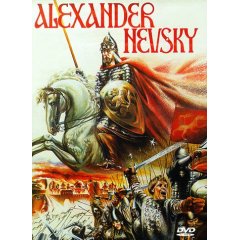 Plot Synopsis: It is the 13th century, and Russia is overrun by foreign invaders. A Russian knyaz', or prince, Alexander Nevsky, rallies the people to form a ragtag army to drive back an invasion by the Teutonic knights. This is a true story based on the actual battle at a lake near Novgorod.
Amazon.com essential video
Sergei Eisenstein's landmark tale of Russia thwarting the German invasion of the 13th century was wildly popular and quite intentional, given the prevailing Nazi geopolitical advancement and destruction at the time. It can still be viewed as a masterful use of imagery and music, with the Battle on the Ice sequence as the obvious highlight. Unfortunately, the rest of the film pales in comparison. A great score by Prokofiev was effectively integrated by the Russian filmmaker, but stands on its own merit as well. --Bill Desowitz
DVD Description
Director Sergei Eisenstein's epic "Alexander Nevsky" features some of the most beautiful imagery ever put on film, a majestic music score by Prokifiev and a dazzling, climactic battle on a frozen lake.
______________________________________________________
Andrei Rublev - Andrei Tarkovsky
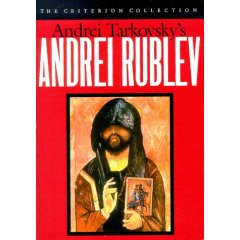 Plot Synopsis: Andreiv Rublev charts the life of the great icon painter through a turbulent period of 15th Century Russian history, a period marked by endless fighting between rival Princes and by Tatar invasions.
Amazon.com
At last, the complete version of Andrei Tarkovski's 1966 masterpiece about the great 15th century Russian icon painter (a film suppressed by the Soviet Union and unseen until 1971) is available. It's a complex and demanding narrative about the responsibility of the artist to participate in history rather than documenting it from a safe distance. A landmark in Russian cinema, Andrei Rublev is a beautifully lyrical black-and-white film about harmony and soulful expression. As the late filmmaker says in a supplementary interview, each generation must experience life for itself; it cannot simply absorb what has preceded it. In fact, a whole host of supplements accompanies the film in this Criterion Collection release. Stick with it; it's worth the effort. --Bill Desowitz
DVD Description
Immediately suppressed by the Soviets in 1966, Andrei Tarkovsky's epic masterpiece is a sweeping medieval tale of Russia's greatest icon painter. Too experimental, too frightening, too violent, and too politically complicated to be released officially, Andrei Rublev has existed only in shortened, censored versions until the Criterion Collection created this complete 205-minute director's cut special edition, now available for the first time on DVD.
______________________________________________________
Battleship Potemkin - Sergei M. Eisenstein and Grigori Aleksandrov
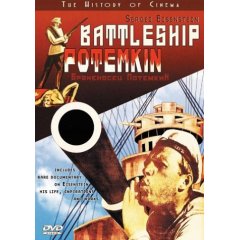 Plot Synopsis: Based on the historical events the movie tells the story of a riot at the battleship Potemkin. What started as a protest strike when the crew was given rotten meat for dinner ended in a riot. The sailors raised the red flag and tried to ignite the revolution in their home port Odessa.
Amazon.com essential video
Sergei Eisenstein's revolutionary sophomore feature has so long stood as a textbook example of montage editing that many have forgotten what an invigoratingly cinematic experience he created. A 20th-anniversary tribute to the 1905 revolution, Eisenstein portrays the revolt in microcosm with a dramatization of the real-life mutiny aboard the battleship Potemkin. The story tells a familiar party-line message of the oppressed working class (in this case the enlisted sailors) banding together to overthrow their oppressors (the ship's officers), led by proto-revolutionary Vakulinchuk. When he dies in the shipboard struggle the crew lays his body to rest on the pier, a moody, moving scene where the citizens of Odessa slowly emerge from the fog to pay their respects. As the crowd grows Eisenstein turns the tenor from mourning a fallen comrade to celebrating the collective achievement. The government responds by sending soldiers and ships to deal with the mutinous crew and the supportive townspeople, which climaxes in the justly famous (and often imitated and parodied) Odessa Steps massacre. Eisenstein edits carefully orchestrated motions within the frame to create broad swaths of movement, shots of varying length to build the rhythm, close-ups for perspective and shock effect, and symbolic imagery for commentary, all to create one of the most cinematically exciting sequences in film history. Eisenstein's film is Marxist propaganda to be sure, but the power of this masterpiece lies not in its preaching but its poetry. --Sean Axmaker
DVD Description
Stylistically, The Battleship Potemkin serves as a revolutionary film, not only in its subject matter, but also in its unique use of montage. As a pioneer who championed a new purpose for cinema, Eisenstein proposed a "kino fist" approach to filmmaking, one in which the film attacks the viewer’s senses with symbolic metaphors, rhythmic editing, and highly-charged melodrama. Includes a rare documentary on Eisentein.
______________________________________________________
Dersu Uzala - Akira Kurosawa
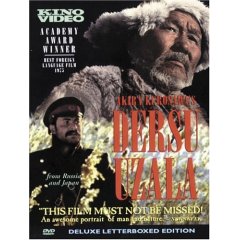 Plot Synopsis: A Russian army explorer who is rescued in Siberia by a rugged Asiatic hunter renews his friendship with the woodsman years later when he returns at the head of a larger expedition. The hunter finds that all his nature lore is of no help when he accompanies the explorer back to civilisation.
Amazon.com essential video
During an unusual chapter in the career of director Akira Kurosawa (Rashomon), the filmmaker went to Russia because he found working in his native Japan to be too difficult. The result was this striking 1975 near-epic based on the turn-of-the-century autobiographical novels of a military explorer (Yuri Solomin) who met and befriended a Goldi man in Russia's unmapped forests. Kurosawa traces the evolution of a deep and abiding bond between the two men, one civilized in the usual sense, the other at home in the sub-zero Siberian woods. There's no question that Dersu Uzala (the film is named for the Goldi character, played by Maxim Munzuk) has the muscular, imaginative look of a large-canvas Soviet Mosfilm from the 1970s. But in its energy and insight it is absolutely Kurosawa, from its implicit fascination with the meeting of opposite worlds to certain moments of tranquility and visual splendor. But nothing looks like Kurosawa more than a magnificent action sequence in which the co-heroes fight against time and exhaustion to stay alive in a wicked snowstorm. For fans of the late legend, this is a Kurosawa not to be missed. --Tom Keogh
DVD Description
Against a backdrop of the treacherous mountains, rivers and icy plains of the Siberian wilderness, acclaimed Japanese director Akira Kurosawa (The Seven Samurai, Rashomon) stages an extraordinary adventure of comradeship and survival. Winner of the Academy Award for Best Foreign Language Film.
______________________________________________________
Destiny of a Man - Sergei Bondarchuk
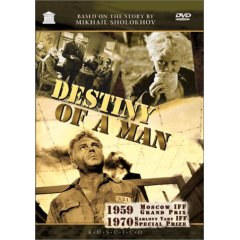 Plot Synopsis: The story of a man (Andrey Sokolov) whose life was ruthlessly crippled by World War II. His wife and daughter were killed during the bombing of his village, he spent some time as a prisoner, and his only son was killed in action only a few days before the victory...
DVD Description
A hymn to the human spirit, this screen adaptation from the novel by Nobel Prize winner Mikhail Sholokhov. After losing his wife and children during the war with fascist Germany and surviving the horrors of a concentration camp, Andrei Sokolov (played by the film's honored director, War and Peace's Sergei Bondarchuk) marches with the Soviet Army towards Berlin and finds a new destiny with a young orphaned boy. Winner of the Grand Prize at the 1959 Moscow IFF and Special Diploma at the 1970 Karlovy Vary IFF.
______________________________________________________
Father of a Soldier - Rezo Chkheidze
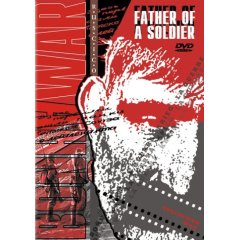 DVD Description
This moving study of war's inhumanity follows the wrenching journey of Georgy, an old peasant winegrower who travels to see his wounded soldier son in the hospital. However, the son has already been sent back out to the front, sending Georgy on a trek with the Soviety Army all the way to Berlin to witness the toppling of fascism. This beautifully filmed and acted Soviet classic in the tradition of "The Cranes Are Flying" remains a pioneering work of cinematic art.
_____________________________________________________
Ivan's Childhood - Andrei Tarkovsky
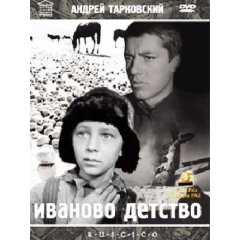 DVD Description
The first full-length feature film by the Great Russian director Andrei Tarkovsky. It caused a popular sensation in cinema world. The film was highly praised by the great 20th-century French writer Jean-Paul Sartre. It got various comments from prominent international cultural figures who admitted that the world had not yet seen such a powerful motion picture about war. The 12-year-old Ivan's childhood ended the day the Fascists shot his mother and sister right before his eyes. Ivan's father was killed in the war. The orphaned boy joins an army detachment, becoming an elusive scout. Risking his life, he brings to his commanders invaluable information about the enemy. But one day he does not come back from his mission...
Awards: St. Mark's Golden Lion at the Venice IFF, 1962; Golden Gate Prize for Best Director at the San Francisco IFF, 1963; Special Diploma at the Karlovy Vary IFF, 1970.
______________________________________________________
Ivan the Terrible Pt.1 - Sergei M. Eisenstein
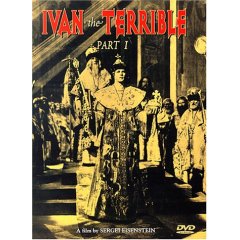 Plot Synopsis: In 1547, Ivan IV (1530-1584), archduke of Moscow, crowns himself Tsar of Russia and sets about reclaiming lost Russian territory. In scenes of his coronation, his wedding to Anastasia, his campaign against the Tartars in Kazan, his illness when all think he will die, recovery, campaigns in the Baltic and Crimea, self-imposed exile in Alexandrov, and the petition of Muscovites that he return, his enemies among the boyars threaten his success. Chief among them are his aunt, who wants to advance the fortunes of her son, a simpleton, and Kurbsky, a warrior prince who wants both power and the hand of Anastasia. Ivan deftly plays to the people to consolidate his power.
Amazon.com
A biography of the first czar of Russia was the final movie project of the great Sergei Eisenstein's life. It would be his undoing, as Stalin was not pleased with part II of this epic. But Ivan the Terrible, Part I still stands as a magnificent, rich, and strange achievement. This is a "composed" film to make Hitchcock look slapdash; every frame is arranged with the eye of a painter or choreographer, the mise-en-scène so deliberately artificial that even the actors' bodies become elements of style. (They complained about contorting themselves to fit Eisenstein's designs.) If you don't believe movies can be art, this could be (and has been) dismissed as ludicrous. But Eisenstein's command of light and shadow becomes its own justification, as the fascinating court intrigue plays out in a series of dynamic, eye-filling scenes. This is not a political theorist, but a director drunk on pure cinema. --Robert Horton
DVD Description
Part One of Sergei Eisenstein's two-part epic chronicling the life of the 16th Century Tsar, Ivan Grozny, is one of film's most artistic and absorbing creations. Over three years in the making, "Ivan the Terrible" features an operatic score by the esteemed Soviet composer Sergei Prokofiev.
______________________________________________________
Ivan the Terrible Pt.2 - Sergei M. Eisenstein and M. Filimmonova
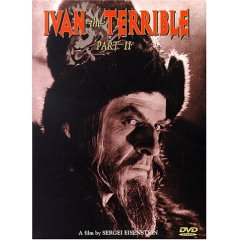 Plot Synopsis: His wife dead from poisoning and his chief warrior, Kurbsky, defected to the Poles, Ivan is lonely as he pursues a unified Russia with no foreign occupiers. Needing friendship, he brings to court Kolychev, now Philip the monk, and makes him metropolitan bishop of Moscow. Philip, however, takes his cues from the boyars and tries to bend Ivan to the will of the church. Ivan faces down Philip and lets loose his private force, the Oprichniks, on the boyars. Led by the Tsar's aunt, Euphrosyne, the boyers plot to assassinate Ivan and enthrone her son, Vladimir. At a banquet, Ivan mockingly crowns Vladimir and sends him in royal robes into the cathedral where the assassin awaits.
Amazon.com
Sergei Eisenstein's saga of Czar Ivan IV continues with the struggle for power and the use of secret police, a controversial segment that caused the film to be banned by Stalin in 1946 (the film was not released until 1958). The predominantly black-and-white film features a banquet dance sequence in color. Obviously the two parts must be viewed as a whole to be fully appreciated. Many film historians consider this period in Eisenstein's career less interesting than his silent period because of a sentimental return to archaic forms (characteristic of Soviet society in the '30s and '40s). Perhaps it was just part of his maturity. --Bill Desowitz
DVD Description
Part Two of Sergei Eisenstein's two-part epic chronicling the life of the 16th Century Tsar, Ivan Grozny, is one of film's most artistic and absorbing creations. Over three years in the making, "Ivan the Terrible" features an operatic score by the esteemed Soviet composer Sergei Prokofiev.
______________________________________________________
Solaris - Andrei Tarkovsky
 Amazon.com
 Plot Synopsis: It is the 13th century, and Russia is overrun by foreign invaders. A Russian knyaz', or prince, Alexander Nevsky, rallies the people to form a ragtag army to drive back an invasion by the Teutonic knights. This is a true story based on the actual battle at a lake near Novgorod.
Amazon.com essential video
Sergei Eisenstein's landmark tale of Russia thwarting the German invasion of the 13th century was wildly popular and quite intentional, given the prevailing Nazi geopolitical advancement and destruction at the time. It can still be viewed as a masterful use of imagery and music, with the Battle on the Ice sequence as the obvious highlight. Unfortunately, the rest of the film pales in comparison. A great score by Prokofiev was effectively integrated by the Russian filmmaker, but stands on its own merit as well. --Bill Desowitz
DVD Description
Director Sergei Eisenstein's epic "Alexander Nevsky" features some of the most beautiful imagery ever put on film, a majestic music score by Prokifiev and a dazzling, climactic battle on a frozen lake.
______________________________________________________
Andrei Rublev - Andrei Tarkovsky
 Plot Synopsis: Andreiv Rublev charts the life of the great icon painter through a turbulent period of 15th Century Russian history, a period marked by endless fighting between rival Princes and by Tatar invasions.
Amazon.com
At last, the complete version of Andrei Tarkovski's 1966 masterpiece about the great 15th century Russian icon painter (a film suppressed by the Soviet Union and unseen until 1971) is available. It's a complex and demanding narrative about the responsibility of the artist to participate in history rather than documenting it from a safe distance. A landmark in Russian cinema, Andrei Rublev is a beautifully lyrical black-and-white film about harmony and soulful expression. As the late filmmaker says in a supplementary interview, each generation must experience life for itself; it cannot simply absorb what has preceded it. In fact, a whole host of supplements accompanies the film in this Criterion Collection release. Stick with it; it's worth the effort. --Bill Desowitz
DVD Description
Immediately suppressed by the Soviets in 1966, Andrei Tarkovsky's epic masterpiece is a sweeping medieval tale of Russia's greatest icon painter. Too experimental, too frightening, too violent, and too politically complicated to be released officially, Andrei Rublev has existed only in shortened, censored versions until the Criterion Collection created this complete 205-minute director's cut special edition, now available for the first time on DVD.
______________________________________________________
Battleship Potemkin - Sergei M. Eisenstein and Grigori Aleksandrov
 Plot Synopsis: Based on the historical events the movie tells the story of a riot at the battleship Potemkin. What started as a protest strike when the crew was given rotten meat for dinner ended in a riot. The sailors raised the red flag and tried to ignite the revolution in their home port Odessa.
Amazon.com essential video
Sergei Eisenstein's revolutionary sophomore feature has so long stood as a textbook example of montage editing that many have forgotten what an invigoratingly cinematic experience he created. A 20th-anniversary tribute to the 1905 revolution, Eisenstein portrays the revolt in microcosm with a dramatization of the real-life mutiny aboard the battleship Potemkin. The story tells a familiar party-line message of the oppressed working class (in this case the enlisted sailors) banding together to overthrow their oppressors (the ship's officers), led by proto-revolutionary Vakulinchuk. When he dies in the shipboard struggle the crew lays his body to rest on the pier, a moody, moving scene where the citizens of Odessa slowly emerge from the fog to pay their respects. As the crowd grows Eisenstein turns the tenor from mourning a fallen comrade to celebrating the collective achievement. The government responds by sending soldiers and ships to deal with the mutinous crew and the supportive townspeople, which climaxes in the justly famous (and often imitated and parodied) Odessa Steps massacre. Eisenstein edits carefully orchestrated motions within the frame to create broad swaths of movement, shots of varying length to build the rhythm, close-ups for perspective and shock effect, and symbolic imagery for commentary, all to create one of the most cinematically exciting sequences in film history. Eisenstein's film is Marxist propaganda to be sure, but the power of this masterpiece lies not in its preaching but its poetry. --Sean Axmaker
DVD Description
Stylistically, The Battleship Potemkin serves as a revolutionary film, not only in its subject matter, but also in its unique use of montage. As a pioneer who championed a new purpose for cinema, Eisenstein proposed a "kino fist" approach to filmmaking, one in which the film attacks the viewer’s senses with symbolic metaphors, rhythmic editing, and highly-charged melodrama. Includes a rare documentary on Eisentein.
______________________________________________________
Dersu Uzala - Akira Kurosawa
 Plot Synopsis: A Russian army explorer who is rescued in Siberia by a rugged Asiatic hunter renews his friendship with the woodsman years later when he returns at the head of a larger expedition. The hunter finds that all his nature lore is of no help when he accompanies the explorer back to civilisation.
Amazon.com essential video
During an unusual chapter in the career of director Akira Kurosawa (Rashomon), the filmmaker went to Russia because he found working in his native Japan to be too difficult. The result was this striking 1975 near-epic based on the turn-of-the-century autobiographical novels of a military explorer (Yuri Solomin) who met and befriended a Goldi man in Russia's unmapped forests. Kurosawa traces the evolution of a deep and abiding bond between the two men, one civilized in the usual sense, the other at home in the sub-zero Siberian woods. There's no question that Dersu Uzala (the film is named for the Goldi character, played by Maxim Munzuk) has the muscular, imaginative look of a large-canvas Soviet Mosfilm from the 1970s. But in its energy and insight it is absolutely Kurosawa, from its implicit fascination with the meeting of opposite worlds to certain moments of tranquility and visual splendor. But nothing looks like Kurosawa more than a magnificent action sequence in which the co-heroes fight against time and exhaustion to stay alive in a wicked snowstorm. For fans of the late legend, this is a Kurosawa not to be missed. --Tom Keogh
DVD Description
Against a backdrop of the treacherous mountains, rivers and icy plains of the Siberian wilderness, acclaimed Japanese director Akira Kurosawa (The Seven Samurai, Rashomon) stages an extraordinary adventure of comradeship and survival. Winner of the Academy Award for Best Foreign Language Film.
______________________________________________________
Destiny of a Man - Sergei Bondarchuk
 Plot Synopsis: The story of a man (Andrey Sokolov) whose life was ruthlessly crippled by World War II. His wife and daughter were killed during the bombing of his village, he spent some time as a prisoner, and his only son was killed in action only a few days before the victory...
DVD Description
A hymn to the human spirit, this screen adaptation from the novel by Nobel Prize winner Mikhail Sholokhov. After losing his wife and children during the war with fascist Germany and surviving the horrors of a concentration camp, Andrei Sokolov (played by the film's honored director, War and Peace's Sergei Bondarchuk) marches with the Soviet Army towards Berlin and finds a new destiny with a young orphaned boy. Winner of the Grand Prize at the 1959 Moscow IFF and Special Diploma at the 1970 Karlovy Vary IFF.
______________________________________________________
Father of a Soldier - Rezo Chkheidze
 DVD Description
This moving study of war's inhumanity follows the wrenching journey of Georgy, an old peasant winegrower who travels to see his wounded soldier son in the hospital. However, the son has already been sent back out to the front, sending Georgy on a trek with the Soviety Army all the way to Berlin to witness the toppling of fascism. This beautifully filmed and acted Soviet classic in the tradition of "The Cranes Are Flying" remains a pioneering work of cinematic art.
_____________________________________________________
Ivan's Childhood - Andrei Tarkovsky
 DVD Description
The first full-length feature film by the Great Russian director Andrei Tarkovsky. It caused a popular sensation in cinema world. The film was highly praised by the great 20th-century French writer Jean-Paul Sartre. It got various comments from prominent international cultural figures who admitted that the world had not yet seen such a powerful motion picture about war. The 12-year-old Ivan's childhood ended the day the Fascists shot his mother and sister right before his eyes. Ivan's father was killed in the war. The orphaned boy joins an army detachment, becoming an elusive scout. Risking his life, he brings to his commanders invaluable information about the enemy. But one day he does not come back from his mission...
Awards: St. Mark's Golden Lion at the Venice IFF, 1962; Golden Gate Prize for Best Director at the San Francisco IFF, 1963; Special Diploma at the Karlovy Vary IFF, 1970.
______________________________________________________
Ivan the Terrible Pt.1 - Sergei M. Eisenstein
 Plot Synopsis: In 1547, Ivan IV (1530-1584), archduke of Moscow, crowns himself Tsar of Russia and sets about reclaiming lost Russian territory. In scenes of his coronation, his wedding to Anastasia, his campaign against the Tartars in Kazan, his illness when all think he will die, recovery, campaigns in the Baltic and Crimea, self-imposed exile in Alexandrov, and the petition of Muscovites that he return, his enemies among the boyars threaten his success. Chief among them are his aunt, who wants to advance the fortunes of her son, a simpleton, and Kurbsky, a warrior prince who wants both power and the hand of Anastasia. Ivan deftly plays to the people to consolidate his power.
Amazon.com
A biography of the first czar of Russia was the final movie project of the great Sergei Eisenstein's life. It would be his undoing, as Stalin was not pleased with part II of this epic. But Ivan the Terrible, Part I still stands as a magnificent, rich, and strange achievement. This is a "composed" film to make Hitchcock look slapdash; every frame is arranged with the eye of a painter or choreographer, the mise-en-scène so deliberately artificial that even the actors' bodies become elements of style. (They complained about contorting themselves to fit Eisenstein's designs.) If you don't believe movies can be art, this could be (and has been) dismissed as ludicrous. But Eisenstein's command of light and shadow becomes its own justification, as the fascinating court intrigue plays out in a series of dynamic, eye-filling scenes. This is not a political theorist, but a director drunk on pure cinema. --Robert Horton
DVD Description
Part One of Sergei Eisenstein's two-part epic chronicling the life of the 16th Century Tsar, Ivan Grozny, is one of film's most artistic and absorbing creations. Over three years in the making, "Ivan the Terrible" features an operatic score by the esteemed Soviet composer Sergei Prokofiev.
______________________________________________________
Ivan the Terrible Pt.2 - Sergei M. Eisenstein and M. Filimmonova
 Plot Synopsis: His wife dead from poisoning and his chief warrior, Kurbsky, defected to the Poles, Ivan is lonely as he pursues a unified Russia with no foreign occupiers. Needing friendship, he brings to court Kolychev, now Philip the monk, and makes him metropolitan bishop of Moscow. Philip, however, takes his cues from the boyars and tries to bend Ivan to the will of the church. Ivan faces down Philip and lets loose his private force, the Oprichniks, on the boyars. Led by the Tsar's aunt, Euphrosyne, the boyers plot to assassinate Ivan and enthrone her son, Vladimir. At a banquet, Ivan mockingly crowns Vladimir and sends him in royal robes into the cathedral where the assassin awaits.
Amazon.com
Sergei Eisenstein's saga of Czar Ivan IV continues with the struggle for power and the use of secret police, a controversial segment that caused the film to be banned by Stalin in 1946 (the film was not released until 1958). The predominantly black-and-white film features a banquet dance sequence in color. Obviously the two parts must be viewed as a whole to be fully appreciated. Many film historians consider this period in Eisenstein's career less interesting than his silent period because of a sentimental return to archaic forms (characteristic of Soviet society in the '30s and '40s). Perhaps it was just part of his maturity. --Bill Desowitz
DVD Description
Part Two of Sergei Eisenstein's two-part epic chronicling the life of the 16th Century Tsar, Ivan Grozny, is one of film's most artistic and absorbing creations. Over three years in the making, "Ivan the Terrible" features an operatic score by the esteemed Soviet composer Sergei Prokofiev.
______________________________________________________
Solaris - Andrei Tarkovsky
 Amazon.com
 The Russian answer to 2001, and very nearly as memorable a movie. The legendary Russian director Andrei Tarkovsky made this extremely deliberate science-fiction epic, an adaptation of a novel by Stanislaw Lem. The story follows a cosmonaut (Donatas Banionis) on an eerie trip to a planet where haunting memories can take physical form. Its bare outline makes it sound like a routine space-flight picture, an elongated Twilight Zone episode; but the further into its mysteries we travel, the less familiar anything seems. Even though Tarkovsky's meanings and methods are sometimes mystifying, Solaris has a way of crawling inside your head, especially given the slow pace and general lack of forward momentum. By the time the final images cross the screen, Tarkovsky has gone way beyond SF conventions into a moving, unsettling vision of memory and home. Well worthy of cult status, Solaris is both challenging art-house fare and a whacked-out head trip. --Robert Horton
______________________________________________________
Stalker - Andrei Tarkovsky
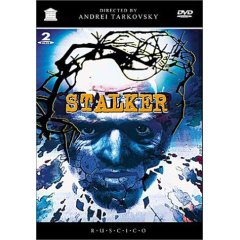 Plot Synopsis: Near a gray and unnamed city is the Zone, an alien place guarded by barbed wire and soldiers. Over his wife's numerous objections, a man rises in the dead of night: he's a stalker, one of a handful who have the mental gifts (and who risk imprisonment) to lead people into the Zone to the Room, a place where one's secret hopes come true. That night, he takes two people into the Zone: a popular writer who is burned out, cynical, and questioning his genius; and a quiet scientist more concerned about his knapsack than the journey. In the deserted Zone, the approach to the Room must be indirect. As they draw near, the rules seem to change and the stalker faces a crisis.
DVD Description
This science fiction milestone from director Andrei Tarkovsky (Solaris) takes you into the Zone, a mysterious, guarded realm containing a mystical Room in which occupants' secret dreams come true. Stalker, a man able to lead others to this holy grail, escorts a writer and a scientist through this foreboding territory and confronts several unexpected challenges along the way. Based on the novel "Roadside Picnic" by Russian sci-fi writers Arkady and Boris Strugatsky.
______________________________________________________
Strike - Sergei M. Eisenstein
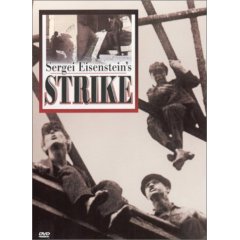 Plot Synopsis: In Russia's factory region during Czarist rule, there's restlessness and strike planning among workers; management brings in spies and external agents. When a worker hangs himself after being falsely accused of thievery, the workers strike. At first, there's excitement in workers' households and in public places as they develop their demands communally. Then, as the strike drags on and management rejects demands, hunger mounts, as does domestic and civic distress. Provocateurs recruited from the lumpen and in league with the police and the fire department bring problems to the workers; the spies do their dirty work; and, the military arrives to liquidate strikers.
Amazon.com essential video
Sergei Eisenstein's debut film is more than a landmark of Soviet cinema; it's easily one of the most thrilling and inventive films to emerge from the silent era of Russian filmmaking. Eisenstein was a theater director and stage designer with some very specific ideas about the cinema, and he put them into practice telling the story of a worker's strike in pre-Revolution Russia, portraying the struggle not of leader against leader, but of the proletariat against the factory owners, enlivened by a conspiratorial subplot involving a quartet of insidious spies sent to infiltrate the ranks of labor. The subject matter is at times didactic and the acting often hammy and overwrought, but the technique is vibrant and the images striking. Eisenstein's compositions reflect the graphic boldness of contemporary poster art, mixing poetic realism with grotesque expressionism in a gripping style, and his famous montage editing style (to be perfected in his next film, Potemkin) is raw, experimental, and energetic. Eisenstein's later films are more consistent and elegant, but none of them have the sheer cinematic invention and energy of this first film. The new score composed and performed by the idiosyncratic Alloy Orchestra combines a mix of martial and mood music on synthesizer with the driving percussion of drums, wood blocks, bells, and wrecking yard of clanging metal objects--a dynamic soundtrack to one of the most auspicious directoral debuts ever. --Sean Axmaker
DVD Description
Sergei Eisenstein's "Strike," with Orson Welles' "Citizen Kane," mark the most outstanding cinematic debuts in the history of film. Triggered by the suicide of a worker unjustly accused of theft, a strike is called by the laborers of a Moscow factory. The managers, owner and the Czarist government dispatch infiltrators in an attempt to break the workers unity. Unsuccessful, they hire the police and, in the film's most harrowing and powerful sequences, the unarmed strikers are slaughtered in a brutal confrontation. This edition of "Strike" is digitally remastered from a mint-condition 35mm print made from the original camera negative and features new digital stereo music composed and performed by the Alloy Orchestra.
______________________________________________________
The Mirror - Andrei Tarkovsky
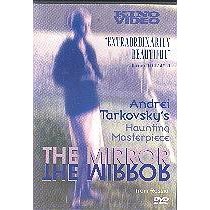 Plot Synopsis: The director mixes flashbacks, historical footage and original poetry to illustrate the reminiscences of a dying man about his childhood during World War II, adolescence, and a painful divorce in his family. The story interweaves reflections about Russian history and society.
______________________________________________________
The Sacrifice - Andrei Tarkovsky
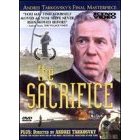 Plot Synopsis: Alexander, a journalist and former actor and philosopher, tells his little son how worried he is about the lack of spirituality of modern mankind. In the night of his birthday, the third world war breaks out. In his despair Alexander turns himself in a prayer to God, offering him everything to have the war not happened at all.
Stalker - Andrei Tarkovsky
 Plot Synopsis: Near a gray and unnamed city is the Zone, an alien place guarded by barbed wire and soldiers. Over his wife's numerous objections, a man rises in the dead of night: he's a stalker, one of a handful who have the mental gifts (and who risk imprisonment) to lead people into the Zone to the Room, a place where one's secret hopes come true. That night, he takes two people into the Zone: a popular writer who is burned out, cynical, and questioning his genius; and a quiet scientist more concerned about his knapsack than the journey. In the deserted Zone, the approach to the Room must be indirect. As they draw near, the rules seem to change and the stalker faces a crisis.
DVD Description
This science fiction milestone from director Andrei Tarkovsky (Solaris) takes you into the Zone, a mysterious, guarded realm containing a mystical Room in which occupants' secret dreams come true. Stalker, a man able to lead others to this holy grail, escorts a writer and a scientist through this foreboding territory and confronts several unexpected challenges along the way. Based on the novel "Roadside Picnic" by Russian sci-fi writers Arkady and Boris Strugatsky.
______________________________________________________
Strike - Sergei M. Eisenstein
 Plot Synopsis: In Russia's factory region during Czarist rule, there's restlessness and strike planning among workers; management brings in spies and external agents. When a worker hangs himself after being falsely accused of thievery, the workers strike. At first, there's excitement in workers' households and in public places as they develop their demands communally. Then, as the strike drags on and management rejects demands, hunger mounts, as does domestic and civic distress. Provocateurs recruited from the lumpen and in league with the police and the fire department bring problems to the workers; the spies do their dirty work; and, the military arrives to liquidate strikers.
Amazon.com essential video
Sergei Eisenstein's debut film is more than a landmark of Soviet cinema; it's easily one of the most thrilling and inventive films to emerge from the silent era of Russian filmmaking. Eisenstein was a theater director and stage designer with some very specific ideas about the cinema, and he put them into practice telling the story of a worker's strike in pre-Revolution Russia, portraying the struggle not of leader against leader, but of the proletariat against the factory owners, enlivened by a conspiratorial subplot involving a quartet of insidious spies sent to infiltrate the ranks of labor. The subject matter is at times didactic and the acting often hammy and overwrought, but the technique is vibrant and the images striking. Eisenstein's compositions reflect the graphic boldness of contemporary poster art, mixing poetic realism with grotesque expressionism in a gripping style, and his famous montage editing style (to be perfected in his next film, Potemkin) is raw, experimental, and energetic. Eisenstein's later films are more consistent and elegant, but none of them have the sheer cinematic invention and energy of this first film. The new score composed and performed by the idiosyncratic Alloy Orchestra combines a mix of martial and mood music on synthesizer with the driving percussion of drums, wood blocks, bells, and wrecking yard of clanging metal objects--a dynamic soundtrack to one of the most auspicious directoral debuts ever. --Sean Axmaker
DVD Description
Sergei Eisenstein's "Strike," with Orson Welles' "Citizen Kane," mark the most outstanding cinematic debuts in the history of film. Triggered by the suicide of a worker unjustly accused of theft, a strike is called by the laborers of a Moscow factory. The managers, owner and the Czarist government dispatch infiltrators in an attempt to break the workers unity. Unsuccessful, they hire the police and, in the film's most harrowing and powerful sequences, the unarmed strikers are slaughtered in a brutal confrontation. This edition of "Strike" is digitally remastered from a mint-condition 35mm print made from the original camera negative and features new digital stereo music composed and performed by the Alloy Orchestra.
______________________________________________________
The Mirror - Andrei Tarkovsky
 Plot Synopsis: The director mixes flashbacks, historical footage and original poetry to illustrate the reminiscences of a dying man about his childhood during World War II, adolescence, and a painful divorce in his family. The story interweaves reflections about Russian history and society.
______________________________________________________
The Sacrifice - Andrei Tarkovsky
 Plot Synopsis: Alexander, a journalist and former actor and philosopher, tells his little son how worried he is about the lack of spirituality of modern mankind. In the night of his birthday, the third world war breaks out. In his despair Alexander turns himself in a prayer to God, offering him everything to have the war not happened at all.
Subscribe to:
Posts (Atom)